![[Motion Wellness Chiropractoc Logo 1]_ed](https://static.wixstatic.com/media/60308a_b058d25614e34bb3b1f8de12f87d4081~mv2.png/v1/crop/x_0,y_131,w_1536,h_728/fill/w_203,h_121,al_c,q_85,usm_0.66_1.00_0.01,enc_avif,quality_auto/%5BMotion%20Wellness%20Chiropractoc%20Logo%201%5D_ed.png)

Common Questions About Chiropractic Care For Older Adults
For many older adults, yes. Growing older does not automatically mean chiropractic care is unsafe. Rather than focusing on a diagnosis or imaging findings alone, we perform a thorough assessment to understand your symptoms, medical history, medications, physical function, lifestyle, and personal goals to develop individualised treatment plan. Depending on your situation, treatment may include gentle joint mobilisation, soft tissue therapy, exercise rehabilitation, balance training, education, or spinal manipulation where appropriate. At Motion Wellness, our goal is to provide the safest, most appropriate care while helping you improve your comfort, movement, physical function, and confidence.
1. Is Chiropractic Care Safe For Older Adults?

Often, yes. Having osteoporosis does not automatically mean chiropractic care is unsafe. Following a comprehensive assessment, treatment is modified according to your fracture risk, medical history, physical function, and examination findings. For many people, care focuses on gentle manual therapy, exercise rehabilitation, mobility exercises, balance training, and education rather than higher-force spinal manipulation. Our goal is to help you move safely and confidently while respecting your individual fracture risk.
2. Can I Receive Chiropractic Care If I Have Osteoporosis?

Although chiropractic care cannot reverse osteoarthritis, it may help you stay active and improve your quality of life. Current clinical guidelines recommend education, exercise, and regular physical activity as the foundation of osteoarthritis management. Where appropriate, treatment may also include manual therapy to help improve joint mobility, reduce pain, and make movement more comfortable. Our goal is to help you keep moving well—not avoid movement because of arthritis.
3. Can Chiropractic Help If I Have Osteoarthritis?

Potentially, yes. Falls are influenced by many factors including muscle strength, balance, walking ability, reaction time, vision, medications, and overall physical function. Where appropriate, we assess these factors and develop an individualised programme that may include strength training, balance exercises, mobility work, and education. Our goal is to help you move with greater confidence, maintain your independence, and reduce your risk of falls.
4. Can Chiropractic Help Reduce My Risk of Falls?

Understanding Common Age-Related Changes
Growing older brings natural changes throughout the body. Many age-related changes on X-rays and MRI are a normal part of ageing. This does not always explain pain and mean you have to stop doing the things you enjoy.
1. Osteoarthritis (OA)
Osteoarthritis (OA) is a common joint condition, particularly as we get older. Although it is often described as “wear and tear,” this is an oversimplification. OA involves changes within the whole joint, which can contribute to pain, stiffness and difficulty with everyday activities.
-
Why Does Osteoarthritis Hurt?
There is no single reason why an arthritic joint hurts. People with similar-looking X-rays can experience very different levels of pain. Pain can be influenced by the joint itself, muscle strength and physical capacity, activity levels, sleep and recovery, general health, stress, and how the nervous system processes pain. A flare-up does not necessarily mean that the joint has become more damaged.


-
source from Pedersini et al (2026)
-
Does My Scan Explain My Pain?
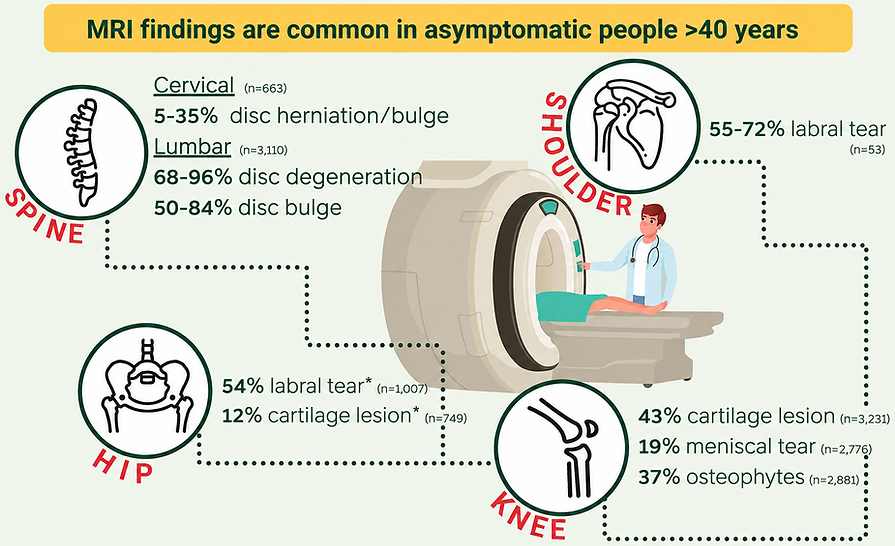
Changes within the joint can contribute to pain and stiffness, but X-ray or MRI findings do not always match how much pain someone has or how well they can move. Structural changes can also be found in people without pain. This is why we look at how you feel and function—not just what your scan looks like.
-
adapted from Culvenor, A.G. et al (2021)
-
What Current Evidence Suggests
For most people with OA, staying active and exercising regularly are important parts of management. Prolonged avoidance of movement lead to gradual decline in strength, fitness and confidence of movement. The goal is not to simply “push through” pain, but to find an appropriate starting point and gradually build your capacity over time.
Current management may include:
✔ Regular physical acitivity to improve capacity
✔ Education and understanding what influences your symptoms
✔ Gradually returning to meaningful activities
✔ Adjusting activity and recovery during flare-ups

-
source from Pedersini et al (2026)
2. Osteoporosis (Weakening Of Bone)
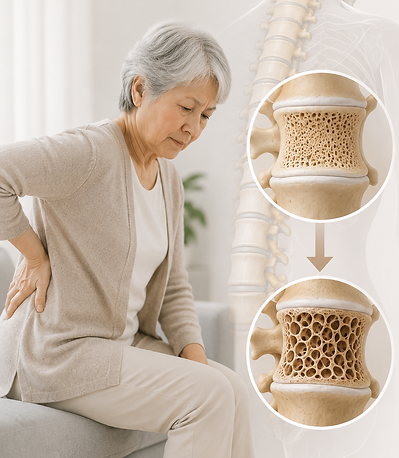
Bone is living tissue that is constantly being broken down and rebuilt throughout life. As we age—particularly after menopause—bone loss may occur faster than new bone can be formed, reducing bone strength and increasing fracture risk. Although osteoporosis increases fracture risk, it does not mean you should avoid movement. At Motion Wellness, our goal is to help you stay active safely while building confidence in movement.
-
What Current Evidence Suggests
✔ Progressive resistance (strength) training
✔ Regular weight-bearing physical activity
✔ Balance training for falls prevention
✔ Adequate calcium and vitamin D
✔ Appropriate medical management where indicated
-
Why Does Exercise Matter?
Bones respond to regular loading. Appropriate exercise helps stimulate bone, maintain muscle strength, improve balance, and reduce the risk of falls—all of which contribute to stronger bones and a lower risk of fractures.
3. Sarcopenia (Age-related muscle loss)
Muscle strength naturally declines as we age, making everyday activities such as climbing stairs, getting out of a chair, carrying groceries, or walking longer distances more difficult. At Motion Wellness, our goal is to help you build the strength needed to stay active, independent, and confident as you age.
-
What Current Evidence Suggests
✔ Progressive resistance (strength) training
✔ Regular physical activity
✔ Adequate protein intake
✔ Early intervention before significant weakness develop
-
Why Does Strength Training Matter?
Strong muscles support your joints, improve balance, make everyday movements easier, and help reduce the risk of falls and loss of independence. Muscles remain highly adaptable throughout life and continue to respond to appropriate strength training—even in older adults

4. Falls Injury related with reduced balance
Changes in muscle strength, reaction time, vision, and the vestibular system can gradually affect balance as we age. While falls become more common, many are preventable. At Motion Wellness, our goal is to help you move with greater confidence while reducing your risk of falls.
-
What Current Evidence Suggests
✔ Balance & functional training
✔ Progressive lower limb strengthening
✔ Regular physical activity
✔ Falls prevention strategies
-
Why Does Balance Training Matter?
Good balance isn't just about reducing falls. It's also about giving you the confidence to keep moving and continue doing the activities you enjoy.

How We Can Support Your Healthy Ageing
1. Comprehensive Assessment
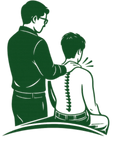
Every person ages differently. Before recommending treatment, we take the time to understand your symptoms, movement, strength, balance, medical history, overall health, and personal goals. This allows us to develop a treatment plan that is appropriate for you—not simply based on your age or diagnosis.
✔ Detailed history

✔ Movement assessment

✔ Static & Motion Palpation
✔ Functional test

✔ Strength test

✔ X-rays if needed

2. Healthy Ageing Care
Healthy ageing is about more than simply reducing pain. At Motion Wellness, our goal is to help you move with confidence, maintain your independence, and continue doing the activities that matter most to you.
Hands-on care
Hands-on care tailored to tailored to your individual needs to support your comfortable movement

-
Gentle joint mobilisation
-
Chiropractic adjustment
-
Soft tissue therapy
Exercise
Individualised exercises designed to help you stay active, improve physical capacity, and prepare for the physical demands of labour and birth.
-
Strengthening exercise
-
Balance training
-
Functional movement training

Healthy Ageing Education
We provide practical, evidence-informed education to support your heathy ageing

-
Understanding ageing changes
-
Self-management strategies
-
Support bone health
Reference
Australian Commission on Safety and Quality in Health Care (2017) Osteoarthritis of the Knee Clinical Care Standard.
Bannuru, R.R., Osani, M.C., Vaysbrot, E.E., et al. (2019) OARSI Guidelines for the Non-Surgical Management of Knee, Hip, and Polyarticular Osteoarthritis.
Basedow, M., Esterman, A., et al. (2023) Systematic Review of International Clinical Practice Guidelines for Osteoarthritis.
Camacho, P.M., Petak, S.M., Binkley, N., et al. (2020) American Association of Clinical Endocrinology Clinical Practice Guideline for the Diagnosis and Treatment of Postmenopausal Osteoporosis.
Cruz-Jentoft, A.J., Bahat, G., Bauer, J., et al. (2019) Sarcopenia: Revised European Consensus on Definition and Diagnosis (EWGSOP2).
Culvenor, A.G., Ferraz Pazzinatto, M. and Heerey, J.J. (2021) Infographic: When is abnormal normal? Reframing MRI abnormalities as a normal part of ageing. British Journal of Sports Medicine, 55(13), pp. 761–762.
Eastell, R., Rosen, C.J., Black, D.M., et al. (2019) Pharmacological Management of Osteoporosis in Postmenopausal Women: An Endocrine Society Clinical Practice Guideline.
Hawk, C., Schneider, M., Dougherty, P., et al. (2010) Best Practices Recommendations for Chiropractic Care for Older Adults.
Hunter, D.J. and Bierma-Zeinstra, S. (2019) Osteoarthritis. The Lancet.
Kolasinski, S.L., Neogi, T., Hochberg, M.C., et al. (2020) 2020 American College of Rheumatology Guideline for the Management of Osteoarthritis of the Hand, Hip, and Knee.
Lan, M., Ding, H., Cao, Y., Liu, J., Tu, L., Fu, S. and Guo, W. (2026) Gut Microbiota and Aging: Current Understanding and Future Perspectives. Molecular Biomedicine.
National Institute for Health and Care Excellence (2022) Osteoarthritis in Over 16s: Diagnosis and Management (NG226).
National Osteoporosis Guideline Group (2024) Clinical Guideline for the Prevention and Treatment of Osteoporosis.
OARSI (2021) Osteoarthritis Prevention Consensus Statement.
OARSI (2025) Year in Review: Osteoarthritis.
Pedersini, P., Rossettini, G. and Villafañe, J.H. (2026) ‘Osteoarthritis pain masterclass: Moving beyond structure to mechanism-based clinical reasoning’, Musculoskeletal Science and Practice, 86, 103641. doi:10.1016/j.msksp.2026.103641.
Royal Australian College of General Practitioners (2024) Guidelines for Preventive Activities in General Practice.
Schielke, A.L., et al. (2026) Efficacy of Spinal Manipulative Therapy in Older Adults with Chronic Spinal Conditions: An Updated Systematic Review.
The Korean Society of Menopause (2024) Clinical Practice Guideline for Osteoporosis