![[Motion Wellness Chiropractoc Logo 1]_ed](https://static.wixstatic.com/media/60308a_b058d25614e34bb3b1f8de12f87d4081~mv2.png/v1/crop/x_0,y_131,w_1536,h_728/fill/w_203,h_121,al_c,q_85,usm_0.66_1.00_0.01,enc_avif,quality_auto/%5BMotion%20Wellness%20Chiropractoc%20Logo%201%5D_ed.png)

Hip Pain Treatment in Canberra
Helping You Move Beyond Hip Pain
Hip pain can affect people of all ages and activity levels. Depending on the structures involved, pain may be felt in the groin, side of the hip, buttock, or even down the thigh. While some hip pain originates from the hip joint itself, symptoms can also be influenced by muscles, tendons, the lower back, and surrounding tissues.
Where Do You Feel Hip Pain?
Hip pain is not always felt directly in the hip joint itself. Depending on the structures involved, pain may be experienced in the groin, side of the hip, buttock, or even further down the thigh or leg. While pain location alone cannot diagnose a condition, understanding where you feel pain can provide useful clues during assessment and help identify the most likely source of your symptoms.
1. Front Of The Hip (Groin)
Pain felt in the front of the hip or groin may be associated with structures inside or around the hip joint. Groin pain is one of the most common locations for symptoms originating from the hip joint itself.
-
People often notice symptoms when:
- Sitting for prolonged periods
- Squatting
- Pivoting or twisting
- Getting in and out of a car
- Running or sporting activities
-
Possible source include:
- Hip joint structures
- Labrum
- Cartilages
- Hip flexor tendons e.g., Iliopsoas
- Adductor muscles
- Groin-related structures


2. Side Of The Hip
Pain on the outside of the hip is often related to the tendons, bursae, and soft tissues around the greater trochanter (the bony prominence on the side of the hip) rather than the hip joint itself. These conditions are commonly referred to as Greater Trochanteric Pain Syndrome (GTPS). However, symptoms in this area can sometimes be influenced by the lower back or nearby nerves, which is why a thorough assessment is important.

-
People may notice symptoms when:
- Lying on the affected side
- Walking for longer distances
- Climbing stairs
- Standing on one leg
- Crossing their legs
-
Possible source include:
- Greater trochanter region
- Gluteal tendons
- Bursa around the greater trochanter
- Iliotibial band
- Nearby nerve irritation
- Referred from the lower back
3. Buttock Pain
Buttock pain does not always originate from the hip itself and may be referred from nearby structures such as the deep gluteal muscles, lower back, pelvis, or sacroiliac joint. Because symptoms can overlap, a thorough assessment is often required to identify the most likely source.
-
People may notice symptoms when:
- Sitting for prolonged periods
- Standing after prolonged sitting
- Walking uphill
- Climbing stairs
- Running
-
Possible source include:
- Deep gluteal muscles
- Proximal hamstring tendon
- Sacroiliac joint
- Sciatic nerve
- Referral from the lower back

4. Pain That Travels Down The Leg
Pain that travels into the thigh, calf, or foot does not always originate from the hip itself. Some people may also experience neurological symptoms such as numbness, tingling, burning sensation or weakness. Symptoms extending below the knee are more commonly associated with the lower back or nervous system than the hip joint itself.
-
People may notice symptoms when:
- Walking for prolonged periods
- Standing for extended periods
- Bending or lifting
- Coughing or sneezing (in some cases)
-
Possible source include:
- Lumbar spine
- Sciatic nerve
- Peripheral nerves
- Referred from the lower back
- Hip-related conditions (Less common)

Common Causes Of Hip Pain
1. Hip Osteoarthritis
Hip osteoarthritis is a degenerative joint condition that may affect the cartilage, bone, joint capsule, and surrounding muscles.
- Deep Groin pain
- Pain that may travel into the thigh or knee
- Hip stiffness (especially in the morning)
- Reduced hip movement
- Difficulty putting on socks or shoes
- Difficulty walking long distances
-
Common symptoms may include:


2. Hip-Related Groin Pain
Hip-related groin pain is common in active individuals and athletes. In some cases, symptoms may be associated with structures inside the hip joint, including the labrum, cartilage, or the shape of the hip joint itself. Some people with FAI may also demonstrate changes in hip muscle strength, movement patterns, and pelvic mechanics, which may contribute to pain and reduced function.
-
Common examples include:
- Femoroacetabular impingement (FAI)
- Labral irritation or tear
- Cartilage-related conditions
-
Common symptoms may include:
- Deep groin pain
- Pain with squatting (due to lack of posterior pelvic tilt)
- Pain during sport participation
- Clicking or catching sensations
- Reduced hip mobility & stiffness


3. Iliopsoas-Related Groin Pain
The iliopsoas is a deep hip flexor muscle group that can contribute to pain at the front of the hip or groin. Iliopsoas-related symptoms can overlap with hip joint-related pain, so assessment is important.
-
Common symptoms may include:
- Pain at the front of the hip
- Pain with resisted hip flexion
- Pain with hip flexor stretching
- Pain with running, kicking, or repeated hip flexion
- Snapping or clicking at the front of the hip in some cases
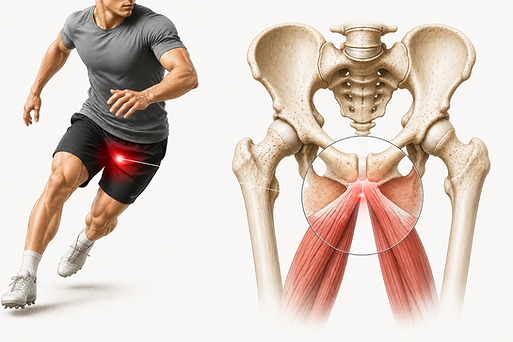
4. Adductor-Related Groin Pain
Adductor-related groin pain commonly affects athletes involved in running, kicking, and change-of-direction sports.
-
Common symptoms may include:
- Groin pain during sport
- Pain with sprinting
- Pain with kicking
- Pain during change of direction
- Tenderness near the adductor tendon attachment
- Pain with resisted adduction testing
5. Meralgia Paresthetica
Meralgia paresthetica is irritation or compression of the lateral femoral cutaneous nerve, a sensory nerve that supplies the outer thigh. This condition may be influenced by compression near the inguinal ligament, tight clothing, weight changes, pregnancy, diabetes, or other contributing factors.
-
Common symptoms may include:
-
Burning pain over the outer thigh
-
Tingling
-
Numbness
-
Altered skin sensation
-
Symptoms usually remaining above the knee


6. Greater Trochanteric Pain Syndrome (GTPS)
GTPS refers to pain around the greater trochanter. GTPS is not simply “bursitis.” It is commonly associated with gluteal tendon irritation and may involve nearby bursae or soft tissues.
-
Common symptoms may include:
- Pain on the outside of the hip
- Pain lying on the affected side
- Pain climbing stairs
- Pain walking longer distances
- Pain standing on one leg
- Tenderness over the outer hip

7. Proximal Hamstring Tendinopathy
Proximal hamstring tendinopathy refers to irritation of the hamstring tendon attachment at the bottom of the pelvis (the “sitting bone”). It can sometimes mimic deep gluteal syndrome or sciatica, as symptoms may extend into the buttock or back of the thigh and is often seen in runners and sports involving sprinting, lunging, kicking, or uphill running.
-
Common symptoms may include:
- Deep buttock pain
- Pain when sitting for prolonged periods
- Pain during running or sprinting
- Pain walking uphill
- Pain during lunges, squats, or deadlifts
- Tenderness around the sitting bone


8. Deep Gluteal Syndrome (DGS)
Deep Gluteal Syndrome (DGS) refers to irritation or compression of the sciatic nerve within the deep gluteal region. Historically, symptoms were often attributed solely to piriformis syndrome. However, current research recognises that several structures within the deep gluteal space may contribute to sciatic nerve irritatrion
-
Common symptoms may include:
- Deep buttock pain
- Pain when sitting for prolonged periods
- Pain traveling down into the back of thigh
- Tingling or numbness
- Sciatica-like symptoms

Common Questions About Hip Pain
1. Is My Hip "Worn Out"?
Not necessarily. Many people have age-related changes on imaging without significant pain, while others may experience symptoms despite relatively minor imaging findings. Treatment decisions should be guided by your symptoms, goals, and physical function rather than imaging alone.
2. Should I Stop Exercising?
Current evidence generally supports staying active. Exercise is one of the most consistently recommended treatments for many hip conditions and can help improve pain, mobility, strength, and quality of life.
In many cases, complete rest is not necessary. However, temporarily modifying painful activities can help calm symptoms while you build strength, mobility, and control. The goal of treatment for hip pain is not simply to avoid pain forever, but to help your hip tolerate movement and activity better over time.
-
Depending on your presentation, this may involve:
- Reducing painful movements for a short period
- Modifying running, squatting, stairs, or sport-specific tasks
- Improving hip strength and control
- Gradually reloading the hip
- Returning to activity in a structured way
3. Do I Need Surgery?
Most people with hip pain do not require surgery. Conservative management is often recommended before considering surgical options.
4. Why Does My Hip Click Or Pop?
Hip clicking, popping, or snapping sensations are relatively common and do not always indicate damage or injury.
In many cases, these sensations occur when tendons move over bony structures around the hip. Some people experience clicking without any pain or functional limitations. However, if the clicking is accompanied by pain, catching, locking, weakness, or reduced function, an assessment may help determine whether further investigation is required.
-
Internal snapping hip (Iliopsoas tendon movement at the front of the hip)
-
External snapping hip (Iliotibial band movement on the outside of the hip)
-
Changes within the hip joint, such as labral irritation


When Should I Seek Medical Attention?
Medical assessment may be recommended if you experience:
Significant trauma (Suspected fracture or dislocation)
Progressive leg weakness
Numbness around the saddle area
Loss of bladder or bowel control
Unexplained weight loss
Fever or infection symptoms
Inability to bear weight
-
These symptoms do not necessarily indicate serious disease but should be assessed without delay
How Can We Help With Hip Pain?
Hip pain can be influenced by a variety of structures including the hip joint, muscles, tendons, bursae, nerves, pelvis, and even the lower back. Because many conditions can produce similar symptoms, identifying the most likely source of your pain is an important first step toward effective management. At Motion Wellness, our goal is not simply to reduce pain, but to help you move with greater comfort, confidence, and function.
1. Thorough Assessment
✔ Detailed history

✔ Movement assessment

✔ Strength assessment

✔ Orthopaedic test

✔ Neurological test

✔ X-ray if indicated

2. Understanding your condition & Making sense of your pain
Many people worry that hip pain automatically means significant damage or arthritis. In reality, hip pain is often influenced by a combination of factors including joint irritation, tendon loading, movement patterns, activity levels, sleep, stress, and overall health. Understanding what is contributing to your symptoms can help reduce uncertainty and improve confidence in recovery.


3. Understanding Load And Capacity
Many hip and groin conditions are influenced by the relationship between load and capacity. Activities such as running, sport, gym training, prolonged standing, or sudden changes in activity can increase the demands placed on the hip. Symptoms may develop when these demands exceed the current capacity of the muscles, tendons, joints, or surrounding tissues. This does not always indicate tissue damage. Often, it reflects a temporary mismatch between what the body is being asked to do and what it is currently prepared to tolerate.

4. Treatment
Hands-on care

-
Chiropractic adjustment
-
Joint mobilisation
-
Stretching muscles
-
Soft tissue techniques
Hands-on care may help reduce pain, improve mobility, and make movement more comfortable.
Rehabilitation Exercise
Facilitating recovery and building strength and confidence in movement with long-term resilience
Research consistently supports exercise as an important part of managing many hip conditions.
Lifestyle Guidance

Addressing sleep, stress, diet, misbelief, and daily habits that help recovery
Reference
Dinis, J., Oliveira, J.R., Choupina, B., Marques, P.S., Sá, D. and Sarmento, A., 2024. Athletes with adductor-related groin pain: a narrative review. Cureus.
Enseki, K.R., Bloom, N.J., Harris-Hayes, M., Cibulka, M.T., DiSantis, A., Di Stasi, S., Malloy, P., Clohisy, J.C. and Martin, R.L., 2023. Hip pain and movement dysfunction associated with nonarthritic hip joint pain: a revision. Journal of Orthopaedic & Sports Physical Therapy, 53(7), pp.CPG1–CPG70.
Grimaldi, A., Ganderton, C. and Nasser, A., 2025. Gluteal tendinopathy masterclass: refuting the myths and engaging with the evidence. Musculoskeletal Science and Practice, 76, 103253.
Koc Jr, T.A., Cibulka, M., Enseki, K.R., Gentile, J.T., MacDonald, C.W., Kollmorgen, R.C. and Martin, R.L., 2025. Hip pain and mobility deficits—hip osteoarthritis: revision 2025. Journal of Orthopaedic & Sports Physical Therapy, 55(11), pp.CPG1–CPG31.
Makovitch, S.A., Mills, C.A. and Eng, C., 2020. Update on evidence-based diagnosis and treatment of acetabular labral tears. Current Physical Medicine and Rehabilitation Reports, 8, pp.342–353.
Mosler, A.B., Agricola, R., Weir, A., Hölmich, P. and Crossley, K.M., 2015. Which factors differentiate athletes with hip/groin pain from those without? A systematic review with meta-analysis. British Journal of Sports Medicine, 49, p.810.
National Institute for Health and Care Excellence (NICE), 2022. Osteoarthritis in over 16s: diagnosis and management (NG226). London: NICE.
Nasser, A.M., Vicenzino, B., Grimaldi, A., Anderson, J. and Semciw, A.I., 2021. Proximal hamstring tendinopathy: a systematic review of interventions. International Journal of Sports Physical Therapy, 16(2), pp.288–305.
Osteoarthritis Research Society International (OARSI), 2019. OARSI guidelines for the non-surgical management of knee, hip, and polyarticular osteoarthritis. Osteoarthritis and Cartilage, 27(11), pp.1578–1589.
Thorborg, K., Reiman, M.P., Weir, A., Kemp, J.L., Serner, A., Mosler, A.B. and Hölmich, P., 2018. Clinical examination, diagnostic imaging, and testing of athletes with groin pain: an evidence-based approach to effective management. Journal of Orthopaedic & Sports Physical Therapy, 48(4), pp.239–249.
Yeo, P.Y., Kasivishvanaath, A., Pérez-Carro, L. and Jegathesan, T., 2025. Top ten causes of non-arthritic hip pain: a comprehensive review. World Journal of Orthopedics, 16(6), 107397.
Yoon, Y.H., Hwang, J.H., Lee, H.W., Lee, M., Park, C., Lee, J., Kim, S., Lee, J., de Castro, J.C., Lam, K.H.S., Suryadi, T. and Youn, K.H., 2025. Beyond nerve entrapment: a narrative review of muscle–tendon pathologies in deep gluteal syndrome. Diagnostics, 15, 2531.
Zhang, W., Chen, L. and Tong, P., 2025. Hip muscle changes in femoroacetabular impingement: a systematic review and meta-analysis. Journal of Orthopaedic Surgery and Research, 20, 717.