![[Motion Wellness Chiropractoc Logo 1]_ed](https://static.wixstatic.com/media/60308a_b058d25614e34bb3b1f8de12f87d4081~mv2.png/v1/crop/x_0,y_131,w_1536,h_728/fill/w_203,h_121,al_c,q_85,usm_0.66_1.00_0.01,enc_avif,quality_auto/%5BMotion%20Wellness%20Chiropractoc%20Logo%201%5D_ed.png)

Common Questions About Chiropractic Care During Pregnancy
1. Can I Receive Chiropractic Care During Pregnancy?
For most women with an uncomplicated pregnancy, chiropractic care is generally considered safe. At Motion Wellness Chiropractic, we provide pregnancy-specific care tailored to your stage of pregnancy, symptoms, and individual needs. Treatment techniques, positioning, and support cushions are modified throughout each trimester to maximise comfort while avoiding unnecessary pressure on the abdomen.
-
Is Chiropractic Care Safe During Pregnancy?

-
When Can I Start Care?
There is no "perfect" time to begin chiropractic care. Some women seek care early in pregnancy, while others attend during the second or third trimester as physical discomfort becomes more noticeable. Care can be adapted throughout every stage of pregnancy, including the third trimester, according to your symptoms, goals, and individual needs.

-
What Are The Benefits Of Chiropractic Care During Pregnancy?
Current evidence suggests that pregnancy-specific chiropractic care may help manage pregnancy-related musculoskeletal symptoms, especially low back pain and pelvic-girdle pain while supporting comfortable movement and physical activity throughout pregnancy. At Motion Wellness Chiropractic, we combine pregnancy-specific chiropractic care with prenatal education, individualised prenatal exercise, and self-management strategies to help support a healthy pregnancy journey and prepare for the physical demands of labour and birth.


2. Can I Exercise During Pregnancy?
-
Is Exercise Safe During Pregnancy?
Yes. For most women, current evidence suggests staying physically active during pregnancy is considered both safe and beneficial. Activities may be modified as your pregnancy progresses.
-
How Much Exercise Should I Do?
Current guidelines recommend aiming for at least 150 minutes of moderate-intensity physical activity every week.
-
What Types Of Exercise Are Recommended?
Current guidelines recommend combining a variety of activities, including:
- Walking
- Swimming
- Stationary cycling
- Resistance or strengthening exercises
- Pelvic floor muscle training
- Yoga or gentle stretching where appropriate

-
What Are The Benefits Of Exercise During Pregnancy?
Regular physical activity has been shown to support both maternal and baby health and may help:
- Reduce the risk of gestational diabetes
- Reduce the risk of pregnancy-related high blood pressure
- Reduce excessive gestational weight gain
- Reduce urinary incontinence
- Improve low back and pelvic girdle pain
- Improve mood and reduce symptoms of depression
- Improve overall fitness, sleep, and wellbeing

Pregnancy-Related Pelvic Girdle Pain (PGP)
Pregnancy-related pelvic girdle pain (PGP) is one of the most common musculoskeletal conditions experienced during pregnancy; about 60% pregnant women experience. It refers to pain around the pelvic joints and surrounding muscles that develops during pregnancy or shortly after birth. Although pelvic pain can make everyday activities uncomfortable, it does not usually mean your pelvis is damaged, unstable, or that your baby is at risk. Current evidence shows that PGP is a treatable condition, and most women improve with education, appropriate activity, exercise, and supportive care.
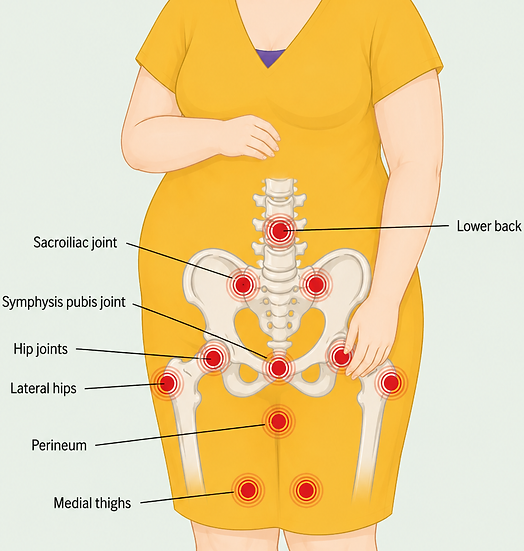
1. Where Do You Feel Pain?
-
Sacroiliac joints (back of the pelvis)
-
Pubic symphysis (front of the pelvis)
-
Lower back
-
Buttocks
-
Groin
-
Lateral hips
-
Inner thighs (less commonly)
2. Common Symptoms Of Pregnancy-Related Pelvic Girdle Pain
Symptoms often fluctuate throughout the day and may become more noticeable as pregnancy progresses.
-
Pain when turning over in bed
-
Pain getting in or out of the car
-
Pain climbing stairs
-
Pain walking for longer distances
-
Pain standing on one leg (e.g. getting dressed)
-
Pain during prolonged standing
-
Clicking, grinding, or clunking sensations around the pelvis
-
Difficulty performing everyday movements involving one leg

3. Understanding Pregnancy-Related Pelvic Girdle Pain
Current evidence does not suggest that the pelvis becomes unstable or "moves out of place." during pregnancy. Although pregnancy hormones increase tissue flexibility and your body naturally changes to support your growing baby by adapting these changes to prepare your body for pregnancy and birth.
-
Your Pelvis Is Strong And Adaptable
Pain does not always reflect tissue injury. During pregnancy, the nervous system may become more sensitive, meaning everyday movements can feel more painful even when the joints and surrounding tissues remain healthy. Pain is real, but it does not necessarily indicate damage to your pelvis or harm to your baby.
-
Pain Does Not Necessarily Mean Damage

There is no single cause of pregnancy-related pelvic girdle pain. Rather than being caused by the pelvis "moving out of place," PGP is now understood as a multifactorial condition involving:
-
What Influences Pregnancy-related PGP
- Pregnancy-related hormonal and physical adaptations
- Increased mechanical demands as your baby grows
- Changes in muscle function and movement strategies
- Previous history of low back or pelvic pain
- Sleep quality, stress, confidence in movement, and other biopsychosocial factors

Rather than focusing on "putting the pelvis back into place," modern management aims to help you move with greater confidence, improve function, and support your body's natural adaptation throughout pregnancy.
How We Can Support Your Pregnancy Journey
1. Comprehensive Assessment
Understanding your pregnancy, symptoms, movement, and individual goals is the first step in providing personalised pregnancy care.
✔ Detailed history

✔ Movement assessment

✔ Static & Motion Palpation

✔ Orthopaedic test

✔ Neurological test

✔ Referral when appropriate

2. Pregnancy-Specific Care
At Motion Wellness Chiropractic, our goal is to help you stay active, move comfortably, and feel informed and confident throughout your pregnancy by combining pregnancy-specific chiropractic care with prenatal education, individualised exercise, and self-management strategies.
Hands-on care
Hands-on care tailored to your stage of pregnancy to improve comfort, support movement, and manage pregnancy-related musculoskeletal symptoms.

-
Chiropractic adjustment
-
Soft tissue techniques
-
Pregnancy-specific methods
Prenatal Exercise
Individualised exercises designed to help you stay active, improve physical capacity, and prepare for the physical demands of labour and birth.

-
Strengthening exercise
-
Pelvic floor training
-
Breathing & relaxation exercises
Lifestyle Guidance
Practical strategies to help you stay comfortable, active, and confident throughout pregnancy.

-
Sleeping position
-
Nutrition guidance
-
Movement strategies
-
Activity modification
Prenatal Education
Practical strategies to help you stay comfortable, active, and confident throughout pregnancy.

-
Understanding your Pregnancy journey
-
Birth plan & preparation
Reference
As-Sanie, S., Ross, W.T. and Till, S.R., 2026. Evaluation and Treatment of Chronic Pelvic Pain. Obstetrics & Gynecology, 147(1), pp.21-43.
Fiat, F., Merghes, P.E., Scurtu, A.D., Almajan Guta, B., Dehelean, C.A., Varan, N. and Bernad, E., 2022. The main changes in pregnancy—therapeutic approach to musculoskeletal pain. Medicina, 58(8), p.1115.
Hall, H., Cramer, H., Sundberg, T., Ward, L., Adams, J., Moore, C., Sibbritt, D. and Lauche, R., 2016. The effectiveness of complementary manual therapies for pregnancy-related back and pelvic pain: A systematic review with meta-analysis. Medicine, 95(38), p.e4723.
Jakes, A., Chadha, K. and Igualada-Martinez, P., 2026. Identifying and managing pregnancy-related pelvic girdle pain. bmj, 393.
Mardon, A.K., Leake, H.B., Wilson, M.V., Karran, E.L., Parker, R., Malani, R., Moseley, G.L. and Chalmers, K.J., 2025. Pain science education concepts for pelvic pain: an e-Delphi of expert clinicians. Frontiers in Pain Research, 6, p.1498996.
Pulsifer, J., Britnell, S., Sim, A., Adaszynski, J. and Dufour, S., 2022. Reframing beliefs and instiling facts for contemporary management of pregnancy-related pelvic girdle pain. British Journal of Sports Medicine, 56(22), pp.1262-1265.
Smajdor, A. and Räsänen, J., 2025. Is pregnancy a disease? A normative approach. Journal of Medical Ethics, 51(1), pp.37-44.
Shanshan, H., Liying, C., Huihong, Z., Yanting, W., Tiantian, L., Tong, J. and Jiawei, Q., 2024. Prevalence of lumbopelvic pain during pregnancy: A systematic review and meta‐analysis of cross‐sectional studies. Acta obstetricia et gynecologica Scandinavica, 103(2), pp.225-240.